Case studies / Mobile Streams
Product design and AI advisory.
- Discipline
- Product design and AI
- My role
- Product Design and AI Advisor
- Timeframe
- July 2026
01 / Overview
Overview
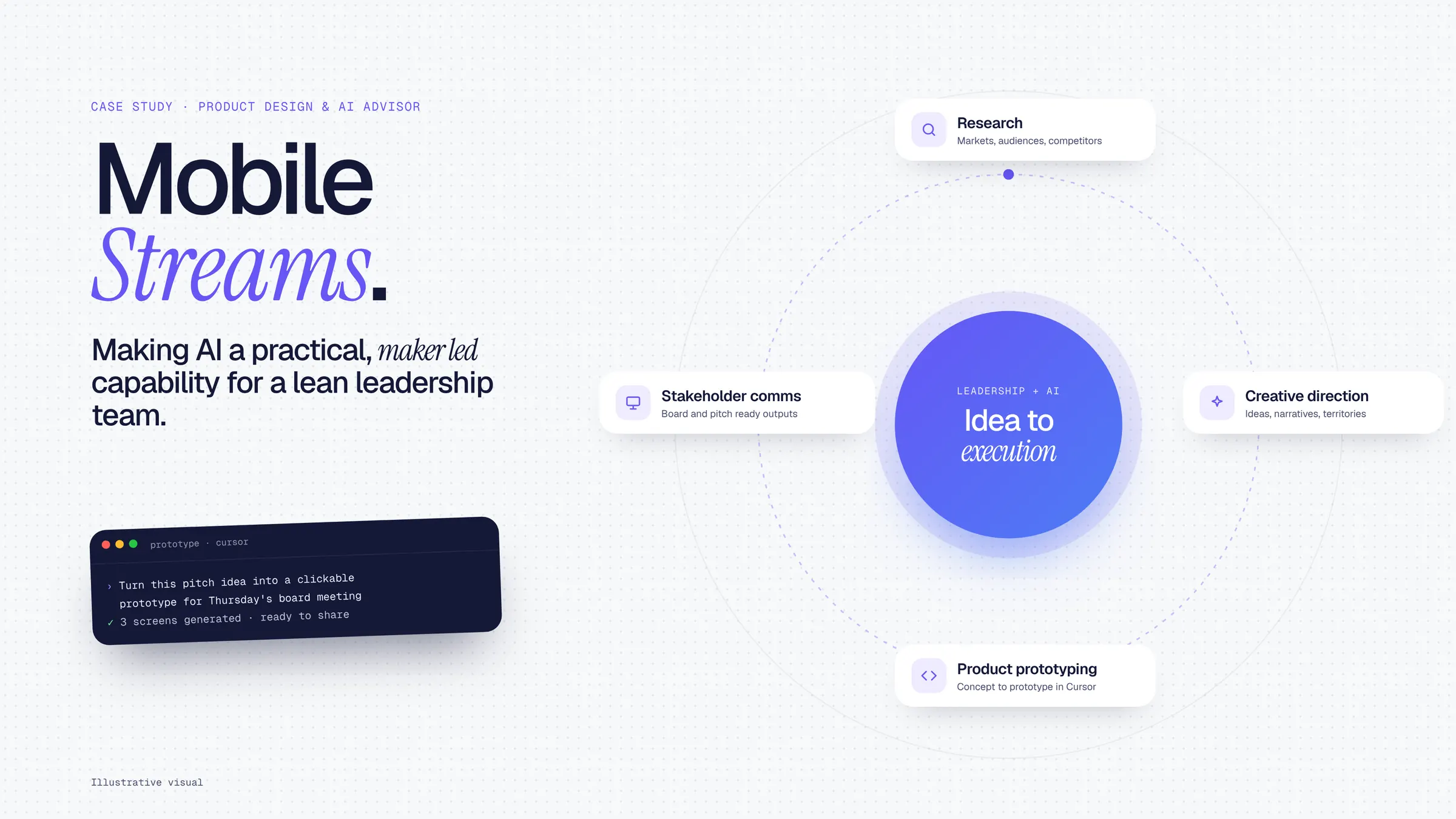
As a Product Design and AI Advisor for Mobile Streams, I worked directly with the leadership team to explore how AI could support the company's creative, product, and business development workflows.
The business recognised the opportunity to use AI not just as a productivity tool, but as a way to move faster from idea to execution.
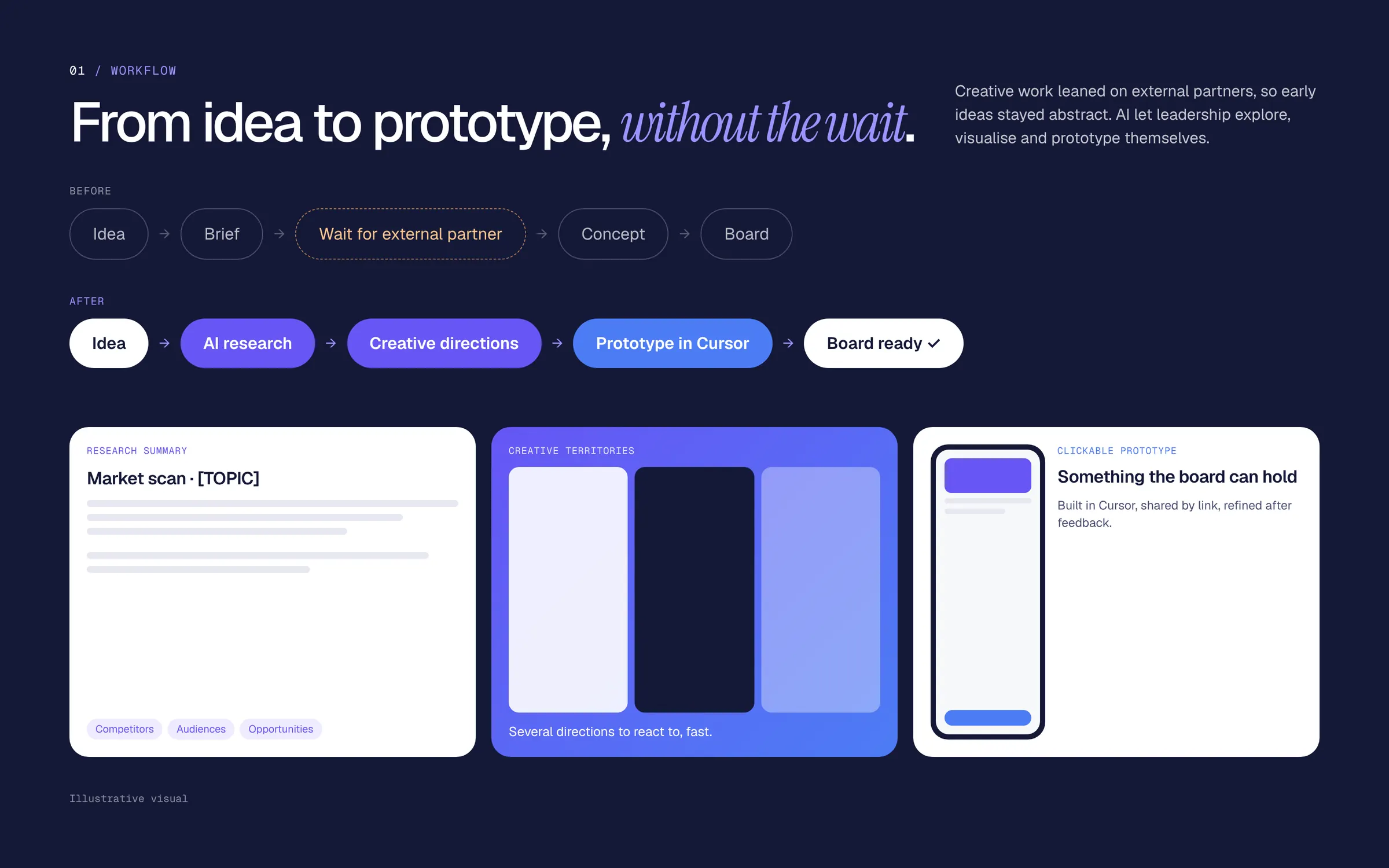
Rather than relying solely on external design and development cycles, AI could help leadership research opportunities, generate creative directions, prototype concepts, and prepare stronger outputs for board and pitch meetings.
This work helped establish a more practical, maker-led approach to AI adoption, giving the business greater confidence in how emerging tools could support day-to-day decision-making and future product opportunities.
02 / The challenge
The challenge
Mobile Streams operated as a lean business, with much of its creative and design execution supported by external partners.
This created flexibility, but also introduced friction when exploring early-stage ideas.
As a result:
- Concepts could take time to visualise
- Creative exploration was dependent on external availability
- Product ideas often remained abstract for too long
- Prototypes for pitches and board discussions required additional effort
- AI tools were emerging quickly, but there was no clear view on where they could create practical value
The challenge wasn't simply introducing AI tools.
It was helping leadership understand how AI could become part of the company's creative and product operating model.
03 / My role
My role
I partnered directly with the leadership team in an advisory role, providing guidance on how AI could be introduced into the business in a practical and focused way.
My responsibilities included:
- Advising leadership on AI adoption opportunities
- Researching and evaluating emerging AI tools
- Identifying where AI could support creative and product workflows
- Introducing AI-assisted research, ideation, and design practices
- Guiding the business towards a maker mentality through tools such as Cursor
- Helping translate ideas into tangible prototypes for pitches, board meetings, and product exploration
The focus was not on building a large internal design function.
It was about giving leadership the capability, confidence, and workflows to move faster.
04 / The vision
The vision
The key shift was moving AI from a topic of exploration to a practical creative and product capability.
Instead of treating AI as something separate from the business, the goal was to embed it into everyday workflows.
AI could support the business across four connected areas:
Research
Faster exploration of markets, audiences, competitors, and product opportunities.
Creative Direction
Rapid generation of ideas, narratives, visual territories, and campaign concepts.
Product Prototyping
Using tools such as Cursor to move from concept to interactive prototype more quickly.
Stakeholder Communication
Creating stronger, more tangible outputs for board discussions, client pitches, and strategic decision-making.
05 / Key design principles
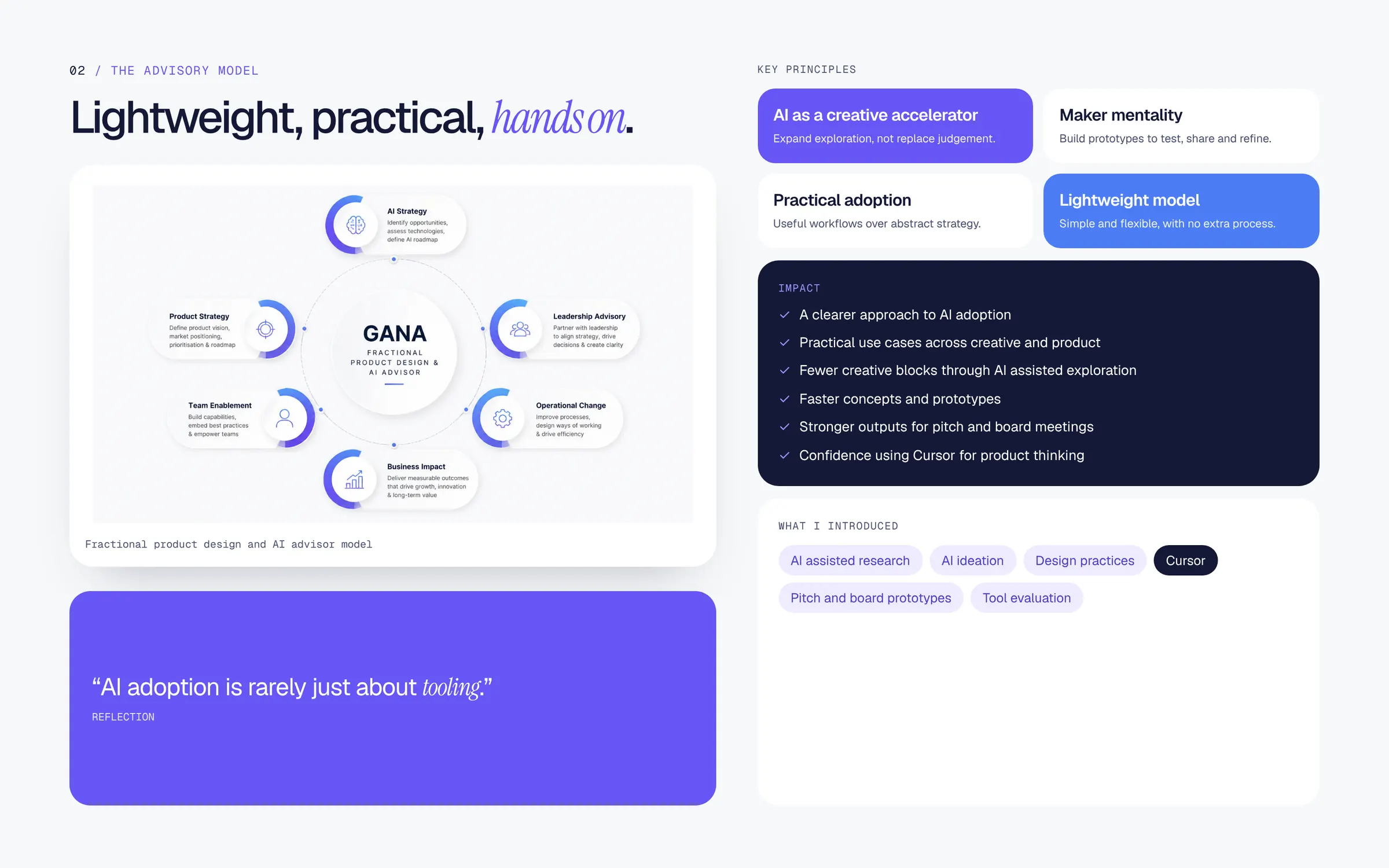
Key design principles
AI as a Creative Accelerator
AI was positioned as a way to expand creative exploration, not replace human judgement.
Maker Mentality
The business was encouraged to move beyond discussion and create tangible prototypes that could be tested, shared, and refined.
Practical Adoption
The focus was on immediate, useful workflows rather than abstract AI strategy.
Lightweight Operating Model
For a smaller business, AI adoption needed to be simple, flexible, and easy to apply without adding unnecessary process.
06 / Impact
Impact
Although this was an advisory engagement rather than a traditional product delivery programme, the work helped Mobile Streams:
- Establish a clearer approach to AI adoption
- Identify practical use cases across creative and product workflows
- Reduce creative blocks through AI-assisted exploration
- Speed up the creation of concepts and prototypes
- Improve the quality of outputs for pitch and board meetings
- Build confidence in using tools such as Cursor to support product thinking
- Create a foundation for future AI-enabled ways of working
07 / Reflection
Reflection
This work reinforced that AI adoption is rarely just about tooling.
For smaller businesses, the real value comes from helping leadership understand what is possible, where to focus, and how to build confidence through practical use.
By introducing lightweight workflows and a maker-led mindset, AI became less of an abstract technology trend and more of a hands-on capability for accelerating ideas, decisions, and opportunities.
Screens
Inside Mobile Streams
Next case study
TPO Mobile