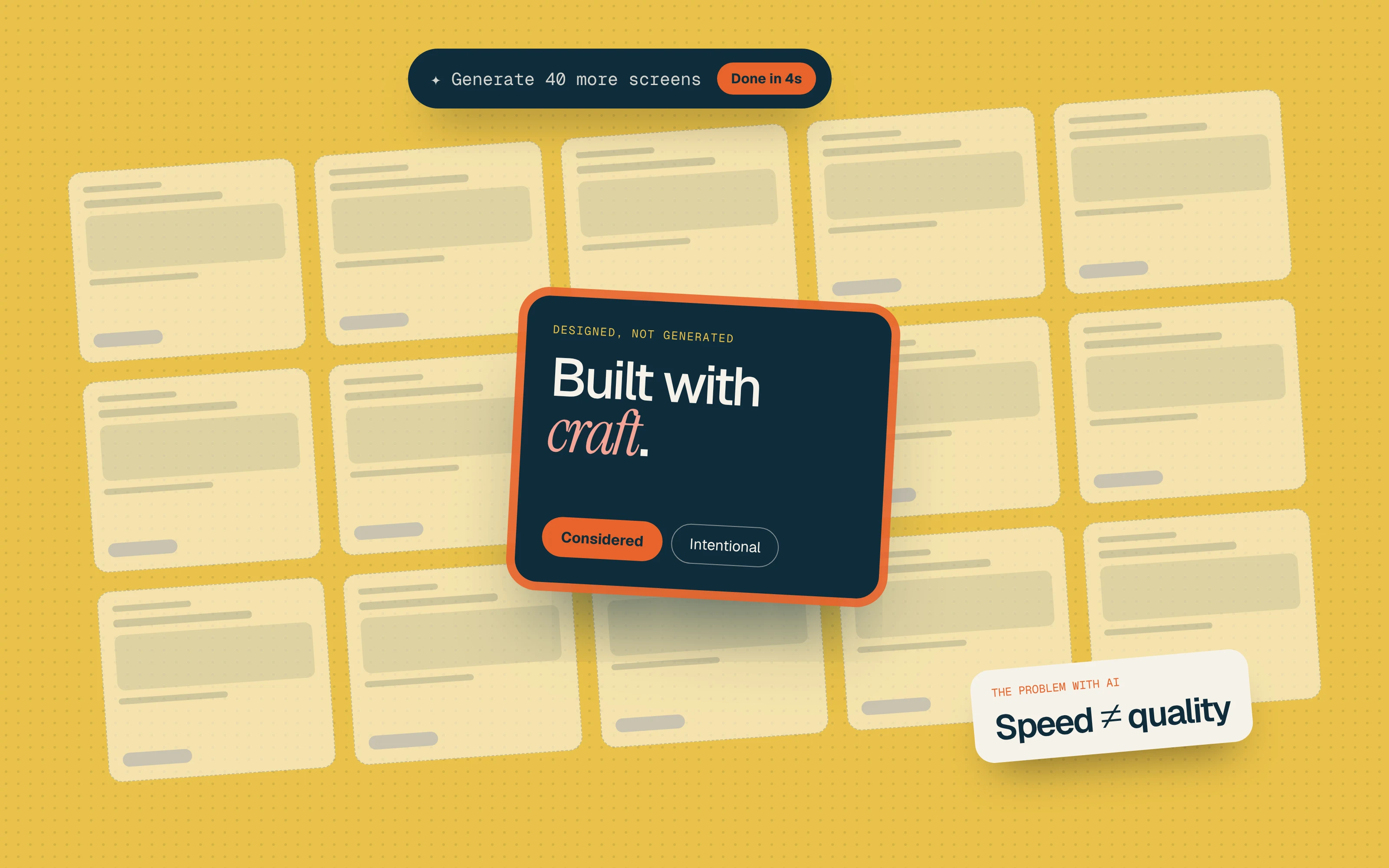
The problem with AI
Everyone seems convinced AI will replace design.
I'm not.
Don't get me wrong—I love the tools. I use them every day. Hell, I built this website in Cursor in less than 24 hours. But here's the interesting part: I probably spent longer adjusting colours, refining the tone, balancing layouts, and tweaking whitespace than I did generating the code itself.
Because that's the bit AI still struggles with.
The failure mode isn't usually the technology. The technology is impressive. The problem is believing that generating something quickly is the same as creating something good.
What actually matters
After months of experimenting with AI-powered design and development tools, I've noticed the same pattern.
The quality of the output is directly tied to the quality of the thinking behind it.
Yes, AI can generate screens, flows, websites, and prototypes in seconds. But if the prompt lacks clarity, context, intent, or understanding of user needs, the result is often generic, disconnected, or just plain wrong.
And if I'm spending hours crafting, refining, and iterating prompts—only to rework the output afterwards—I sometimes wonder whether I could have just opened Figma and designed it myself.
Maybe that's my 25 years of design experience talking. Maybe it's an old-school designer problem.
But good design has never been about moving pixels around a screen. It's about judgement. Understanding trade-offs. Knowing what to remove. Creating balance. Building trust. Solving the right problem.
Those things don't magically appear because a model can generate an interface.
The leadership implication
As design leaders, our job isn't to chase novelty. It's to chase usefulness.
AI can absolutely help us move faster. It can remove friction, accelerate exploration, and help teams get from A to B in record time.
But speed isn't the goal. Better outcomes are.
The organisations that win won't be the ones replacing craft with AI. They'll be the ones using AI to amplify craft.
Here's hoping we find the balance: AI as a powerful co-pilot, not a replacement for experience, judgement, and design thinking.